


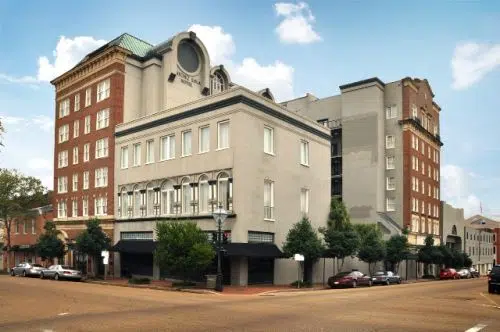
NATCHEZ, Miss. – The Eola hotel’s renovation has been slowed by financial hindrances and other factors, but developers have spent more than $1 million making plans for construction that’s expected to start next year.
“The project is absolutely going to get done,” said Hayes Dent, one of the developers trying to bring back to life the Natchez landmark that’s been vacant since 2014 when the hotel closed.
Dent said an announcement will be made later this year naming “one of the top hotel companies in the world” that is “going to flag this hotel” with its brand.
The downtown Natchez building – built in 1927 – has severely deteriorated while its renovation stalled as developers seek funds and plan its designs. Inflation has been a major impediment: the original $23 million construction costs estimated in 2021 has grown to $31 million for the project, Dent said.
He provided an update Monday at a public gathering organized by Natchez Mayor Dan Gibson.
Dent, Gibson and others in August 2021 announced grand plans for restoring the vacant building as a hotel with expectations construction could begin in 2022 for a 2023 reopening. Dent on Monday acknowledged they “jumped the gun” three years ago before their plans “hit the wall.”
However, “We have never stopped working on that project” as about $1 million has been spent in “predevelopment money” that include expenses for redesigning what Dent said will be a 96-room hotel.
Gibson noted this is a strong indication the Eola’s resurrection will become a reality. “I don’t think people spend over a million dollars on a predevelopment process if they’re not serious,” the mayor said.
Dent said he expects the necessary financing will be assured by March so renovations can begin and take about 14 months. This would come as the building approaches being 100 years old in 2027.
The Eola’s refurbishment has involved property owner Rob Lubin of Virginia, New Orleans restaurateur Dickie Brennan and the MMI Hotel Group, a Mississippi-based company that manages or owns hotels in Mississippi, Alabama, Tennessee, Georgia and Florida.
Natchez native Marjorie Feltus Hawkins and her Nashville-based design firm are also involved in the Eola’s restoration.
The American Cruise Line – whose riverboats dock in Natchez for passengers to visit – is expected to bring overnight guests to the hotel, Dent said.
City officials have discussed with Eola developers various measures for Natchez to help finance the hotel’s renovation like what the city has done in the past to help accommodate the Natchez Grand Hotel and the Holiday Inn Express.
Options include a public tax-increment financing (TIF) measure that involves borrowing money through a bond issue. Local property and sales tax revenues generated by the Eola’s reopening would be used to repay the loan. Such public-financing tools don’t add to the city’s debt.
Natchez aldermen have also endorsed a sales tax-rebate incentive for the Eola hotel’s restoration through a state program for encouraging tourism development.
The hotel previously ceased operations in 1974, but former Natchez mayor Butch Brown spearheaded the drive in 1978 that eventually got the Eola renovated and reopened in 1982.
Bringing the Eola back to life again is considered a key element to revitalizing downtown Natchez.
“The Eola Hotel was the center of social activity in Natchez for most of the 20th Century after its opening in 1927,” states a report posted by the Mississippi Department of Archives & History. “Designed by the New Orleans architectural firm of Weiss, Dreyfous & Seiferth, it was built at a cost of $750,000, and at its grand opening it was hailed by newspaper headlines as a great ‘symbol of civic progress’.”
“Not only was the hotel the principal place of lodging for the many tourists who visited the city, but it also became the social center for the citizens of the town. Its coffee shop was open twenty-four hours a day and served as a rendezvous point for the town’s businessmen during the day and the general populace in the evening. The Eola was also the facility most used by civic clubs and other organizations for banquets and large meetings.”


Comments