


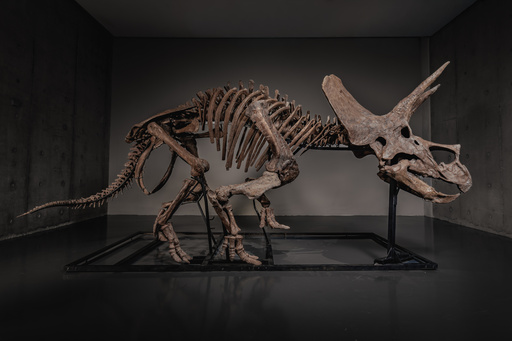
A triceratops skeleton that stood in a Wyoming museum for decades will be auctioned off, a rare instance of a museum-exhibited dinosaur going to the auction block just as the market for the prehistoric giants has hit record highs.
The fossil, dubbed “Trey,” will be open for bidding from March 17 to 31 on Joopiter, an online auction platform founded by Grammy-winning artist and producer Pharrell Williams. It has a preauction estimate of $4.5 million to $5.5 million.
Dating back more than 66 million years to the late Cretaceous period, Trey was discovered near Lusk, Wyoming, in 1993 by Lee Campbell and the late Allen Graffham, a commercial paleontologist who made numerous significant finds over his lifetime.
The 17-foot-long (5.3-meter-long) herbivore greeted visitors at the 1995 grand opening of the Wyoming Dinosaur Center in Thermopolis, and remained there on loan until 2023.
Having been recently sold in a private transaction, it is now in Singapore, where it is available for private viewings through the end of March, Joopiter said.
Trey “has this cultural aspect that a lot of fossils that go to auction these days just simply don’t have,” said paleontologist Andre LuJan, who worked with Joopiter to prepare the fossil for auction. “This one is connected to people and undoubtedly has inspired young children who’ve seen it to pursue a career in paleontology.”
Once the domain of museums and universities, dinosaur fossils have become increasingly popular investments.
In 2024, the remains of “Apex” the stegosaurus went for $44.6 million at auction, shattering the previous record of $31.8 million paid in 2020 for “Stan,” a Tyrannosaurus rex skeleton.
In a sign that the dinosaur fossil market remains strong, a rare young dinosaur skeleton blew past its $4 million to $6 million Sotheby’s preauction estimate in July and ended up fetching more than $30 million in a bidding frenzy, including fees and costs.
Caitlin Donovan, Joopiter’s global head of sales, said the surging interest reflects a shift away from traditional categories like old master paintings and toward objects that have “cultural resonance.”
“(Dinosaurs) have always captivated our imagination … and people are now starting to see the value in investing in these as assets,” LuJan said.
But the hot market has some paleontologists concerned that important specimens could disappear into private collections, depriving scientists of important research opportunities. Public museums are “getting totally priced out of an exploding market,” said Kristi Curry Rogers, a paleontologist at Minnesota’s Macalester College.
“If a fossil goes into a private collection without guaranteed access forever, that data is essentially lost to science,” said Curry Rogers, who is not involved in the sale.
LuJan emphasized that Trey has always been privately owned, and he hopes it will end up in a museum, just like Apex, which is now on display at New York’s American Museum of Natural History after its buyer signed a long-term loan agreement allowing scientists to study it.
“Because we’ve had this paradigm shift in what owning dinosaurs means to society, people are naturally gravitating toward these benevolent situations where they loan them long-term to museums or they end up donating them to a new museum that’s just being born,” LuJan said.


Comments