


New vehicle technology such as automated braking systems can improve safety, but evidence from crashes involving partially automated driving systems and industry research suggest they are less promising, the head of the National Transportation Safety Board said Tuesday.
The NTSB plans to recommend ways to improve partially automated systems, which allow drivers to take their hands off the wheel, following its investigation into two fatal crashes involving Ford’s Blue Cruise system in 2024. The crashes in Texas and Pennsylvania killed three people when the Ford Mustang Mach-E cars slammed into stopped vehicles.
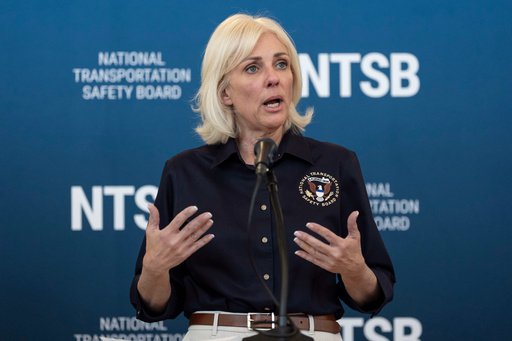
“These systems function primarily as convenience features rather than safety enhancements,” NTSB chair Jennifer Homendy said at the outset of a hearing on its investigation.
One of the challenges for the auto industry in developing systems that take on more driving functions has been how to ensure drivers stay alert. NTSB members said the evidence is clear that drivers using these systems are more likely to shift their focus away from the road.
Currently, there are no clear U.S. government standards for the systems, so each automaker’s version of this technology can vary greatly, said Michael Graham, NTSB vice chair.
Ford and other automakers emphasize that partially automated driving systems are not designed to replace the human drivers sitting behind the wheel, who have to be ready to take control at any time.
The NTSB, which previously investigated a number crashes involving similar systems, including Tesla’s autopilot system, is examining the effectiveness of these systems and how well they monitor driver engagement.
Missy Cummings, a professor of engineering and computing at George Mason University, told The Associated Press on Monday that these crashes highlight some of the dangers of partially autonomous driving systems that allow people to disengage.
“Allowing people to take their hands off the wheel will also mean they will likely take their minds off the driving task,” Cummings said.
Ford’s Blue Cruise system allows drivers to take their hands off the steering wheel while it handles steering, braking and acceleration on highways. The company says the system isn’t fully autonomous and it monitors drivers to make sure they pay attention to the road.
There are no fully autonomous vehicles for sale to the public in the U.S., but robotaxis that operate without a driver are being used in several major cities.
One of the crashes occurred in San Antonio, Texas, killing one person, while the other happened in Philadelphia killing two. The driver in the Philadelphia crash was later charged with DUI homicide. That case is pending, with no trial date set.
The Texas crash occurred on Interstate 10 in San Antonio. The Mach E, going nearly 75 mph, struck the rear of a Honda CR-V that was stopped in the middle of three lanes at night. Investigators said the Ford driver was looking for a nearby charging station, and there was no evidence that either he or the Ford’s automated systems tried to slow the car or swerve.
Another driver who avoided the CR-V told investigators that neither its taillights nor hazards were working at the time. But NTSB investigators said body camera footage shot after the crash showed that some of the CR-V’s lights were on, and that evidence showed that at least one of the taillights was lit up before the crash.
The other crash involving a Mach E killed two people at night on Interstate 95 in Philadelphia. The Pennsylvania State Police said the Ford was in the left lane when it struck a stationary Hyundai Elantra that earlier had collided with a Toyota Prius. The Ford was going 72 mph even though the speed limit in the area had decreased to 45 mph because it was a construction zone.
During the crash, the Prius driver, who was outside of his vehicle, also was struck and thrown into the southbound lanes. A person from the Hyundai also was on the roadway and was hit. Both young men died.
NTSB members expressed concerns Tuesday that drivers who are under the influence of alcohol or drugs seem to believe that using a driver assistance system can help them drive while impaired.


Comments