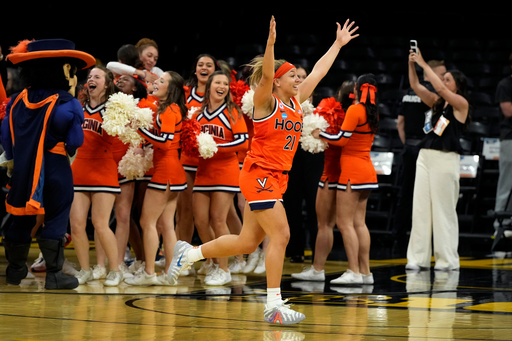
Virginia’s Kymora Johnson remembers anxiously sitting through the unveiling of last season’s NCAA women’s tournament, unsure whether her Cavaliers would make the March Madness cut.
Their name didn’t pop up until the last slot, triggering a “we’re going to show you” motivation that ultimately turned a 10th-seeded First Four team into a Sweet 16 party crasher.
“We were very, very blessed with that opportunity last year,” the all-Atlantic Coast Conference guard said.
Stories like those have long been woven into the fabric of March Madness. Only now, the madness has grown with both the men’s and women’s tournaments going from 68 teams to 76 at the end of the upcoming season.
It theoretically increases the chances for memorable moments that live on in tournament lore. What’s unclear is whether it’s better for mid-majors in getting more teams into the mix — including in landing lucrative “units” payouts for tournament success — or if it just means more power-conference bubble teams gobbling up bids despite flirting with .500 league records.
“I might be in the minority here, and I understand why people don’t like tournament expansion,” Minnesota men’s coach Niko Medved said, “but I actually think it’s going to end up being more exciting than people realize in the next couple of years.”
On the men’s side, the first tournament in 1939 had eight teams, with Oregon beating Texas, Oklahoma and Ohio State to claim the first title.
It expanded to 16 teams in 1951, doubled by 1975, then again to 64 in 1985 to start its modern era. Growth had been smaller since, first to 65 teams with an opening-round game in 2001 and finally to 68 in 2011 to form the “First Four” games in Dayton, Ohio.
For the women, the first tournament arrived in 1982 with 32 teams, with the first expansions going to 40 (1986) and 48 (1989) before reaching the 64-team mark in 1994. The tournament didn’t change again until reaching 68 in 2022 with its own First Four, though games were held at schools hosting opening-week games.
Both are set for 76 in 2027, with 12 opening-round games sending winners into the 64-team bracket.
“I’ve seen the joy of Selection Sunday of a team and a group of kids watching the television and their name comes up,” said Wake Forest men’s coach Steve Forbes, who reached the NCAAs as a head coach at East Tennessee State as well as in assistant stints at Texas A&M, Tennessee and Wichita State.
“I think that’s an unbelievable experience. And then taking them to the open practice and the media the day before, that’s something — win or lose the game — that’s a lifetime memory. So why would we not want that for about 90 other kids?”
The topic of expansion had been frequent over the years on the men’s side in particular with Division I having more than 300 programs.
ACC commissioner Jim Phillips said expansion will improve March Madness. But he acknowledged that push comes amid schools and coaches facing pressure to make good on growing investments in the era of player compensation.
“The investments across the country have never been greater than they are right now,” Phillips told The Associated Press. “And you can only go so long and invest if you’re not able to get to what you want to get to, and that’s postseason play.”
Duke men’s coach Jon Scheyer, leading a blueblood never near the tournament’s cut line, was open-minded on expansion to add a few more games to the opening rounds. He had one caveat: he didn’t want to undermine the buzz from the all-day Thursday first-round games that formerly kicked off the 64-team tournament and still signal the full onset of March Madness.
That meant growing to, say, 96 teams and requiring a full earlier round was a no for him.
“At some point, you have to earn the right to be in it,” Scheyer said. “And I think you have plenty of opportunities for 76. If you can’t be one of the 76 teams — and I would say this if we were 77 — then you don’t deserve to be in it.”
Expansion momentum on the women’s side had increased as the sport grew in popularity and viewership. It’s been particularly notable in recent years with stars like Iowa’s Caitlin Clark or Angel Reese leading LSU to the 2024 national title, and big-name coaches like South Carolina’s Dawn Staley.
“I think we’re in a good place right now,” Ohio State women’s coach Kevin McGuff said. “I’m not so sure we should go much further beyond where we are right now.”
Yet unlike the men playing at neutral-court sites, the women’s tournament has long relied on top seeds hosting opening-week games and trimming the four regional sites to two in 2023 to grow attendance. That now includes the 76-team format’s added games.
“I don’t think that we know yet exactly how that’s going to be,” said UCLA coach Cori Close, whose Bruins won their first NCAA women’s title in April. “My hope is the marketing is really intentional, that we have butts in the seats in the early games. I hope that we have really good coverage and storytelling surrounding some of that. I hope we have great corporate sponsorship that comes alongside those things.
“When you have a big change like that, it’s important that there’s a comprehensive strategy that surrounds it so that we continue to grow our game and we don’t mishandle the growth and the parity that we’re experiencing right now.”
The same question hovers over both brackets: will football-playing power conferences gobble up extra bids or will mid-majors see gains? That’s particularly pertinent after 2024’s realignment with the ACC and Big Ten taking coast-to-coast footprints while the Big 12 and SEC also added schools.
Those leagues had combined for 28 men’s bids in 2023 and 27 in 2024, but rose to 33 in 2025 in the first post-realignment tournament and 35 last year. The growth was bigger on the women’s side, going from 28 in 2023 and 30 in 2024 to 37 in 2025 and 39 last year.
In the Big Ten, commissioner Tony Petitti made it clear he expects his league — coming off a Michigan-led huge showing in last spring’s men’s tournament — to benefit from March Madness expansion, pointing to the league’s depth and regular-season travel demands.
“Giving those teams access and a chance to acquire more spots is going to be really critical,” he said.
Yet that also explains why UConn’s Geno Auriemma, the Hall of Fame women’s coach with 12 NCAA titles, has been blunt in criticizing expansion. In May, he called it “strictly a money grab for the Power Four conferences to get teams that finished 6-10 in their conference to get into the tournament.”
“This kind of is the prequel to their only being 86 or 88 or 92 teams in the tournament, and they all come from four conferences,” he said then. “Or the way it’s going now, maybe there’s only 64 teams and they come from two conferences.”
___
AP freelance writer Luke DeCock in Rosemont, Illinois, contributed to this report.
___
See AP’s full college sports coverage here