


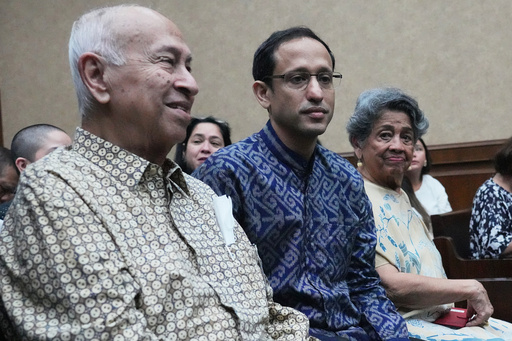
JAKARTA, Indonesia (AP) — Google’s investment in Indonesia’s ride-hailing company GoTo wasn’t in anyway connected to the country’s Education Ministry’s decision to procure Chromebooks for schools during COVID-19 pandemic, former Google executives testified in court on Monday.
The testimony undercut a central allegation by prosecutors in the closely watched corruption trial of Nadiem Anwar Makarim, the co-founder of Gojek and the education minister at the time of the procurement. It took place during the transition to remote learning in schools when classrooms were forced to shut down due to the COVID-19 pandemic.
Makarim, 41, was arrested in September following an investigation into the procurement of Chromebook laptops that prosecutors say caused $125 million in state losses.
Scott Beaumont, former president of Google Asia Pacific in 2019-2014, Caesar Sengupta, former general manager and vice president in 2018-2021, and William Florence, a former executive, testified at Jakarta’s Corruption Court on Monday via Zoom.
The case centers on the allegation that Makarim “enriched himself” in connection with the Chromebooks procurement in 2020-2021, according to the indictment. Prosecutors said he pressed Google to invest in PT Aplikasi Karya Anak Bangsa, known as PT AKAB, the parent company of Gojek.
Makarim, who was education minister in 2019-2024, allegedly favored Google’s Chromebook despite a ministry research team refusing to recommend the laptop model due to ineffectiveness in regions lacking internet access.
The purchase of more than 1.2 million Chromebooks was designed to strengthen Google’s dominance in Indonesia’s educational sector. The program was linked to Google’s investments of about $787 million in PT AKAB through Google Asia Pacific, lead prosecutor Muhammad Fadli Paramajeng said.
Makarim received about 809 billion rupiah ($48.2 million) in connection with the program, prosecutors alleged.
Beaumont denied the allegation. “There was no connection at all between Google’s investment in GoTo and any of the conversations with the Ministry of Education,” he told the panel of three judges. Makarim’s Gojek merged with the country’s biggest e-commerce firm Tokopedia to form the GoTo Group in 2021.
Sengupta also denied the charges.
Google has previously stated that Chromebooks are designed for the realities of the classroom, including those in remote areas. While optimized for the cloud, they are offline-capable even without connectivity. It also said that Google licenses software and does not dictate Chromebooks’ pricing.
Makarim, a Harvard University graduate, co-founded Gojek in 2009, and remained until 2019, when the company was valued at over $10 billion. He stepped down to join the cabinet of former Indonesia President Joko Widodo.
Prosecutors allege his resignation from PT AKAB and Gojek was a “strategic concealment” to mask conflicts of interest while Makarim appointed close associates as directors and “beneficial owners,” allowing him to maintain indirect control over company decisions.
He faces a possible sentence of life imprisonment if found guilty.
Makarim has previously denied any wrongdoing, saying he did not personally receive funds from Chromebook procurement or related services. His defense argued that he divested from PT AKAB upon taking office, his wealth fell by more than 50% during his term and procurement decisions were made by technical teams and officials, not the minister.
The verdict could come as soon as this month. Two former Education Ministry officials and a former tech consultant also were charged in the case, while another staff member remains at large.


Comments